How to Live Faithfully in a Deafening, Fast, and Formative World
Introduction — The Tension Every Christian Feels
Every Christian feels this tension. We live in a world that is deafening, fast, and constantly shaping us. Culture doesn’t just entertain — it forms us. It disciples our desires, our habits, and our vision of the “good life.”
So the question isn’t whether Christians should engage culture. The real question is: How do we stay faithful in the world without being formed by the world?
Culture doesn’t just entertain—it disciples.
1. Culture Is Not Neutral—It Disciples
Culture is always teaching. Always forming. Always discipling.
It tells us what to love, what to fear, what to celebrate, and what to reject. It shapes our imagination long before it shapes our behavior.
The question is never, “Is culture influencing me?” The question is, “How is it influencing me—and do I even notice?”
Every cultural message is a form of discipleship.
2. What Jesus Meant by “In the World, Not of It” (John 17)
Engagement is not optional. Compromise is not allowed.
Jesus Does Not Pray for Escape
In John 17, Jesus rejects the idea of withdrawal or isolation. He doesn’t call His disciples to bunker down until heaven. Instead, He leaves them in the world because that is where their witness matters.
Peter echoes this: “Keep your conduct among the Gentiles honorable…” (1 Peter 2:12)
Jesus Prays for Protection
When Jesus prays, “Keep them from the evil one,” He’s not asking for comfort. He’s asking for spiritual preservation—protection from deception, accusation, and the subtle pull back into darkness.
The Intentional Tension
Jesus wants His people:
- In the world—present, visible, engaged
- Not of the world—distinct, holy, shaped by truth
- Protected from the evil one—spiritually guarded
This is the same tension Jesus lived: fully present among sinners, yet never shaped by sin.
3. Why Culture Matters — Paul at Mars Hill (Acts 17)
Culture matters because people matter.
Before Paul preached at Mars Hill, Luke says he was “provoked” in his spirit (Acts 17:16). The Greek word “παροξύνω” describes a deep, holy disturbance—not irritation, but grief that moved him toward people.
Paul didn’t stand at a distance and critique culture. He entered it with clarity.
He understood their worldview. He identified the cracks. He exposed the contradictions. He proclaimed the truth.
When he saw an altar to an unknown god, he didn’t mock it. He used it: “What you worship as unknown, this I proclaim to you.”
Paul didn’t adopt their culture to fit in—he entered their culture to call them out of darkness.
4. Where Christians Often Go Wrong
There are two common extremes:
This is compromise disguised as strategy.
Isolation happens when you fear the world more than you trust the Word.
Imitation happens when you love the world more than you submit to the Word.
Extreme 1: Isolation — “Culture is dangerous; avoid it.”
This produces believers who are physically present but missionally absent. They can’t interpret the world they live in because they’ve never learned to see it through Scripture.
Extreme 2: Imitation — “Blend in to reach people.”
This looks like:
- Softening conviction to stay accepted
- Adopting cultural values to stay relevant
- Hoping relevance will open a door
- Staying silent once the door opens
Jesus explains why both extremes fail. In John 17:14, He says, “I have given them Your Word, and the world has hated them…” Then in verse 17: “Sanctify them in the truth; Your Word is truth.”
Faithful engagement happens when you are sanctified by the Word while living, sent into the world.
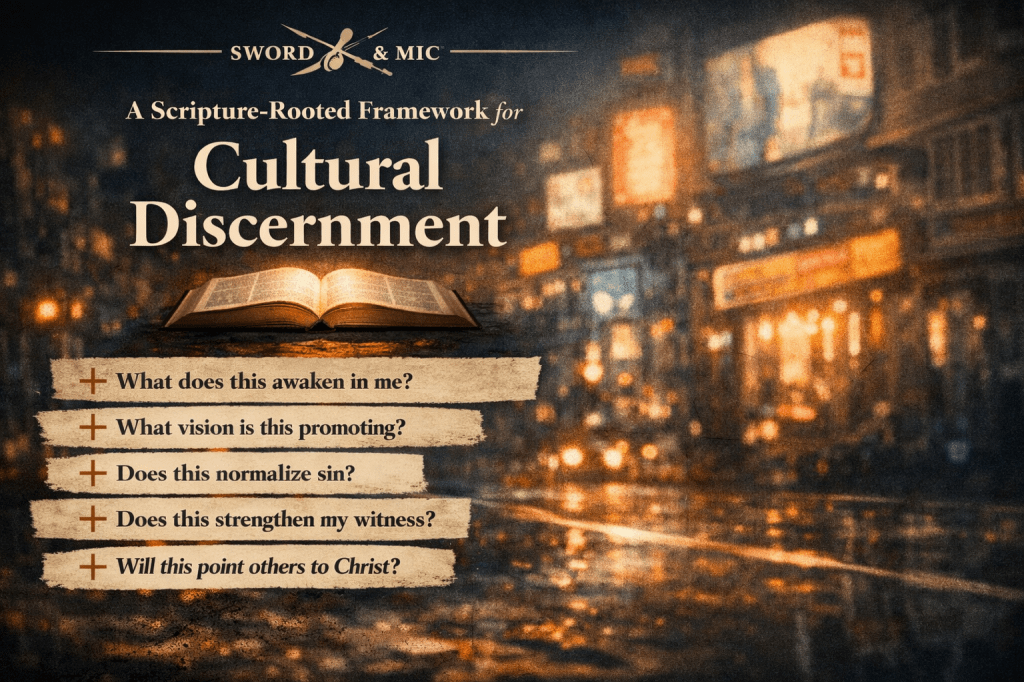
5. A Scripture‑Rooted Framework for Cultural Discernment
If isolation and imitation are the ditches, discernment is the narrow road between them.
Jesus tells us where discernment comes from: “Sanctify them in the truth; Your Word is truth.”
Here are five questions that help you engage culture with clarity, not compromise:
Your presence should clarify Christ, not cloud Him.
1. What desire in me does this awaken?
Temptation begins with desire (James 1:14–15). Culture often disciples our desires before it disciples our beliefs.
“But each person is tempted when he is lured and enticed by his own desire.” -James 1:14
2. What vision of the ‘blessed life’ is this promoting?
Every cultural message points toward a version of the good life. Psalm 1 and Matthew 6 remind us that what we fix our eyes on forms us.
“But his delight is in the law of the LORD, and on his law he meditates day and night.” –Psalm 1:2
“But seek first the kingdom of God and his righteousness, and all these things will be added to you.” -Matthew 6:33
3. Does this normalize what God calls sin?
Isaiah 5:20 warns us about calling evil good. Ephesians 5:11 calls us to expose darkness, not applaud it.
“Woe to those who call evil good and good evil…” -Isaiah 5:20
“Take no part in the unfruitful works of darkness, but instead expose them.” -Ephesians 5:11
4. Does this strengthen or weaken my witness?
Your presence should make Christ clearer, not blurrier.
“Keep your conduct among the Gentiles honorable…” -1 Peter 2:12
5. Would engaging this with others point them toward Christ or toward compromise?
Colossians 4:5–6 and 1 Corinthians 10:31–33 remind us that our engagement is always missional.
“Walk in wisdom towards outsiders…” -Colossians 4:5
“So, whether you eat or drink, or whatever you do, do all to the glory of God.” -1 Corinthians 10:31
6. A Call to Faithful Presence
We don’t need more Christians who hide from culture. We don’t need more Christians who blend into culture. We need believers who can interpret the moment, stand firm in truth, and enter the world with the clarity of Christ.
If this helped you think clearly about how to live faithfully in a shifting culture, share it with someone who needs the same clarity.
We’re building a community of believers who want to be in the world, not of it—grounded in Scripture, engaged with culture, and unafraid to stand firm.
Grace and peace.


Leave a comment